
When a medical emergency strikes, one of the most consequential decisions made in the first few minutes is how the patient will get to definitive care. For most calls, a ground ambulance is dispatched without a second thought. But in certain situations — a severe traumatic injury on a remote highway, a stroke patient hours away from the nearest stroke center, a critically ill child who needs a pediatric intensive care unit — the question of whether to use a ground ambulance or an air ambulance becomes a matter of life and death. That decision is never made arbitrarily. It is guided by clinical protocols, geographic realities, patient condition, and a precise understanding of what each transport mode can and cannot offer. This article breaks down exactly how medical teams evaluate those factors, what air and ground ambulances each bring to the table, and why getting that call right is one of the most critical judgments in emergency medical care.
Understanding the Two Transport Options
Before diving into how the decision is made, it helps to understand what each transport type actually involves. Ground ambulances are the backbone of emergency medical services — mobile treatment units staffed by EMTs and paramedics, equipped with advanced life support capabilities, and capable of reaching most urban and suburban locations within minutes. They are versatile, widely available, and can operate in virtually any weather condition. Advanced life support ground units carry cardiac monitors, defibrillators, airway management equipment, IV medications, and a full complement of trauma and medical supplies. In most emergencies, a well-staffed ground ambulance is entirely capable of delivering the level of care a patient needs during transport.
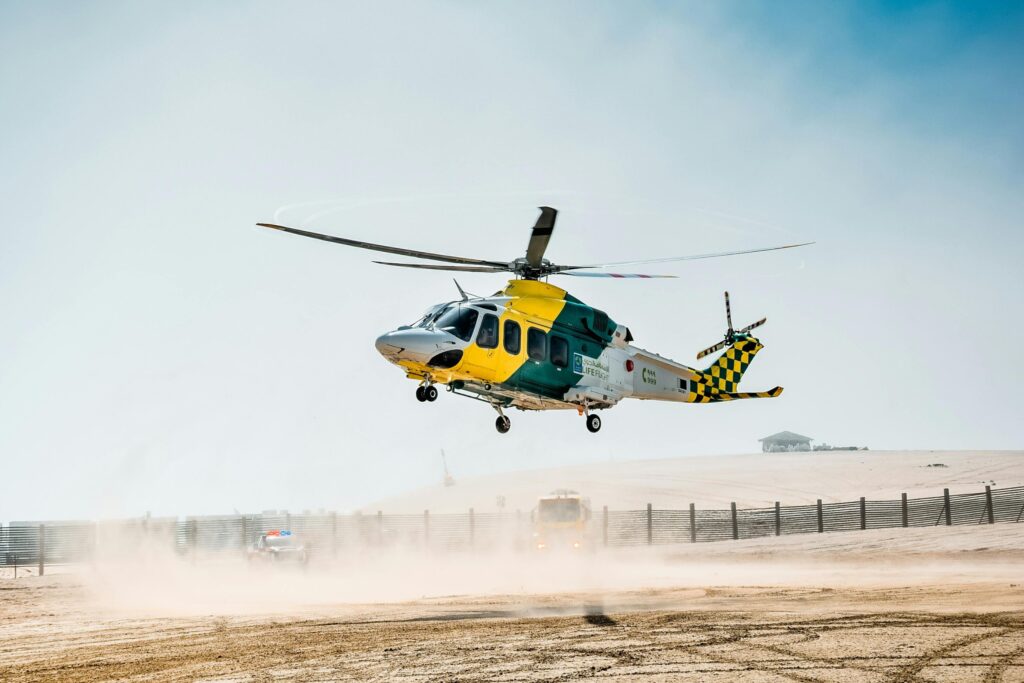
Air ambulances operate in a different category entirely. They come in two primary forms: rotor-wing aircraft, commonly known as helicopter air ambulances (HAA), and fixed-wing aircraft used for longer-distance medical transports. Helicopter ambulances are typically deployed for time-sensitive emergencies where speed and geographic access are critical. They are staffed by highly specialized flight crews that often include flight nurses, flight paramedics, and in some configurations, physicians. The medical equipment on board is as advanced as anything found in a ground unit, but the environment is more constrained — limited space, high noise levels, and altitude-related physiological considerations all add complexity to patient care in flight. Fixed-wing air ambulances are generally used for inter-facility transfers over long distances, often moving critically ill patients between hospitals across states or internationally.
The Core Factors That Drive the Decision
The decision between air and ground transport is driven by a combination of clinical and logistical factors that medical teams assess rapidly, often within minutes of receiving a call or evaluating a patient. The most fundamental question is always: which mode of transport will get this patient to the right level of care in the shortest time with the best chance of a good outcome? That question sounds simple, but answering it requires weighing several variables simultaneously.
Time to definitive care is one of the primary drivers. In trauma medicine, the concept of the “golden hour” — the window of time after a severe injury during which treatment has the greatest impact on survival — makes speed paramount. If a patient with a traumatic brain injury is located ninety minutes by ground from the nearest trauma center but only twenty minutes by helicopter, the calculus strongly favors air transport. The same logic applies to STEMI patients who need a cardiac catheterization lab, stroke patients who need a comprehensive stroke center, and burn patients who need a specialized burn unit. When geography creates a time gap that air transport can close, that gap directly affects the patient’s survival odds.
Patient condition and clinical stability are equally important. A patient who is in full cardiac arrest, for example, may not benefit from air transport because the interventions needed — including uninterrupted CPR, defibrillation, and resuscitation medications — are more effectively delivered in the controlled space of a ground ambulance or even on the scene. Conversely, a patient with a severe but survivable traumatic injury who is stable enough to fly but needs surgery that is not available locally is an ideal candidate for air transport. The clinical picture must match the capabilities and constraints of the transport mode being considered.
When Air Wins: Scenarios That Call for a Helicopter
There are specific clinical and geographic scenarios where air ambulance transport is not just preferable but clearly the better choice. Remote and rural emergencies represent perhaps the most straightforward case. When a patient is injured or becomes critically ill in a location that is simply too far from advanced care for ground transport to deliver them in time, air transport bridges that gap. A farming accident on an isolated rural property, a hiking injury deep in mountainous terrain, or a critical illness on an island accessible only by water are all situations where helicopter or fixed-wing transport may be the only viable option.
Multi-system trauma is another strong indicator for air transport consideration. Patients who have sustained injuries to multiple body systems — traumatic brain injury combined with internal bleeding and orthopedic fractures, for example — often require a level I or level II trauma center with surgical capabilities that are not available at every hospital. If the closest appropriate trauma center is significantly farther than the closest hospital, and the patient’s condition is time-critical, flying them to the right facility rather than driving them to the nearest one can be the difference between survival and death. This concept — taking the patient to the right hospital rather than the closest hospital — is a cornerstone of modern trauma systems.
Pediatric critical care emergencies also frequently warrant air transport. Children in respiratory failure, septic shock, or with serious neurological events may need a pediatric intensive care unit that exists only at a regional children’s hospital. In areas where such facilities are geographically distant, transporting a critically ill child by air with a specialized pediatric flight crew can provide a level of care during transit that no standard ground unit is equipped to match. The specialized training and equipment of a pediatric air transport team in these situations is a genuine clinical advantage.
When Ground Is the Right Call
For all the life-saving capability that air ambulances represent, there are many situations where ground transport is the more appropriate, effective, and safer choice. Urban and suburban emergencies are the clearest example. In a city where a level I trauma center is eight minutes away by ground, deploying a helicopter — which takes time to launch, requires a landing zone to be established, and must then transport the patient to the facility — can actually result in a slower time to care than a well-positioned ground unit. Speed is always relative to the specific geography and circumstances of a given call.
Weather and environmental conditions impose hard limits on air transport that ground units simply do not face. Helicopters cannot fly safely in heavy fog, severe thunderstorms, icing conditions, or high winds beyond certain thresholds. When weather grounds the air ambulance fleet, ground units must be prepared to handle all calls regardless of distance or complexity. Medical teams and dispatch centers are acutely aware of weather windows and maintain contingency plans precisely because air transport availability can change rapidly. Ground transport does not carry this vulnerability, which makes it the more reliable baseline in any EMS system.
Patient condition also sometimes favors ground transport even when air is available. Patients with certain types of injuries or medical conditions may not tolerate the altitude changes, vibration, noise, or confined space of a helicopter cabin. Patients with severe respiratory compromise may be more difficult to manage in the high-altitude, reduced-pressure environment of an aircraft. And patients who are too unstable to survive the delay required to launch and position an air asset may simply need to move immediately by ground to the closest stabilizing facility. The goal is always the best outcome for that specific patient in that specific moment — not the most dramatic transport option.
The Role of Protocols, Medical Direction, and Communication
The decision between air and ground transport does not rest entirely on any single person’s judgment. It operates within a structured framework of protocols, medical oversight, and real-time communication that ensures decisions are made consistently and with appropriate clinical authority. Most EMS systems operate under medical direction, with physician-approved protocols that outline specific criteria for air transport activation — including mechanism of injury, vital sign thresholds, estimated transport times, and facility capabilities. These protocols give paramedics and dispatchers clear decision-support tools rather than forcing them to make complex judgments entirely from scratch in high-pressure moments.
Online medical control — the ability of field paramedics to consult directly with a physician by radio or phone in real time — provides an additional layer of clinical oversight for complex cases that fall outside standard protocol. When a paramedic on scene is uncertain whether a patient meets air transport criteria, a brief consultation with a medical director can clarify the decision quickly and confidently. This human backstop in the protocol system is particularly valuable in ambiguous presentations where the right answer is not immediately obvious.
Communication between EMS crews, dispatch centers, air transport programs, and receiving facilities is the thread that ties the entire system together. When an air transport is activated, the receiving facility is notified immediately so that the appropriate team — trauma surgeons, cardiac interventionalists, neurologists — can be assembled and ready when the aircraft lands. This pre-notification system eliminates wasted time at the destination end and ensures that the speed advantage of air transport translates directly into faster definitive treatment rather than simply faster arrival at an unprepared emergency department.
Conclusion
The decision between air and ground ambulance transport is one of the most consequential calls in emergency medicine, and it is made not on instinct but on a carefully considered framework of clinical criteria, geographic realities, patient-specific factors, and system-level protocols. Both transport modes are essential, and neither is universally superior — the right choice depends entirely on the patient in front of the medical team and the resources available in that moment. What unifies both options is a shared goal: getting the right patient to the right facility with the right level of care in the shortest time possible. Understanding how that decision is made gives patients and families a deeper appreciation for the precision and expertise embedded in emergency medical systems — and a clearer picture of the extraordinary effort that goes into every transport, whether it travels by road or by air.